Delta
Delta is aggressive buy volume minus aggressive sell volume. It condenses the bid/ask split of a bar into a single signed number: positive when buyers were the aggressors, negative when sellers were.
What is delta?
Every trade has an aggressor — the side that crossed the spread. Tally the volume of aggressive buys and subtract the volume of aggressive sells and you get delta. A bar that traded 1,000 of aggressive buying and 600 of aggressive selling has a delta of +400. The same idea applies at a single price level (per-level delta) or across a whole bar (bar delta).
Delta is not the same as volume. A high-volume bar can have near-zero delta if buying and selling were balanced; a quieter bar can have a large delta if one side dominated.
Why does it matter?
Delta puts a direction on participation — it tells you who was aggressive, which raw volume cannot:
- Agreement — price up with positive delta describes buyers driving the move.
- Divergence — price up while delta is flat or negative may reflect buyers lifting offers without much follow-through, or sellers being absorbed.
- Effort vs. result — a large delta that barely moves price is a descriptive sign of absorption at that area.
These are descriptive observations of completed activity, not signals or predictions.
How traders use it
- Reading bar-by-bar delta to see whether aggression is building or fading through a move.
- Looking for delta divergence against price near a level as added context.
- Dropping into per-level delta on a footprint to see exactly where the aggression sat inside a bar.
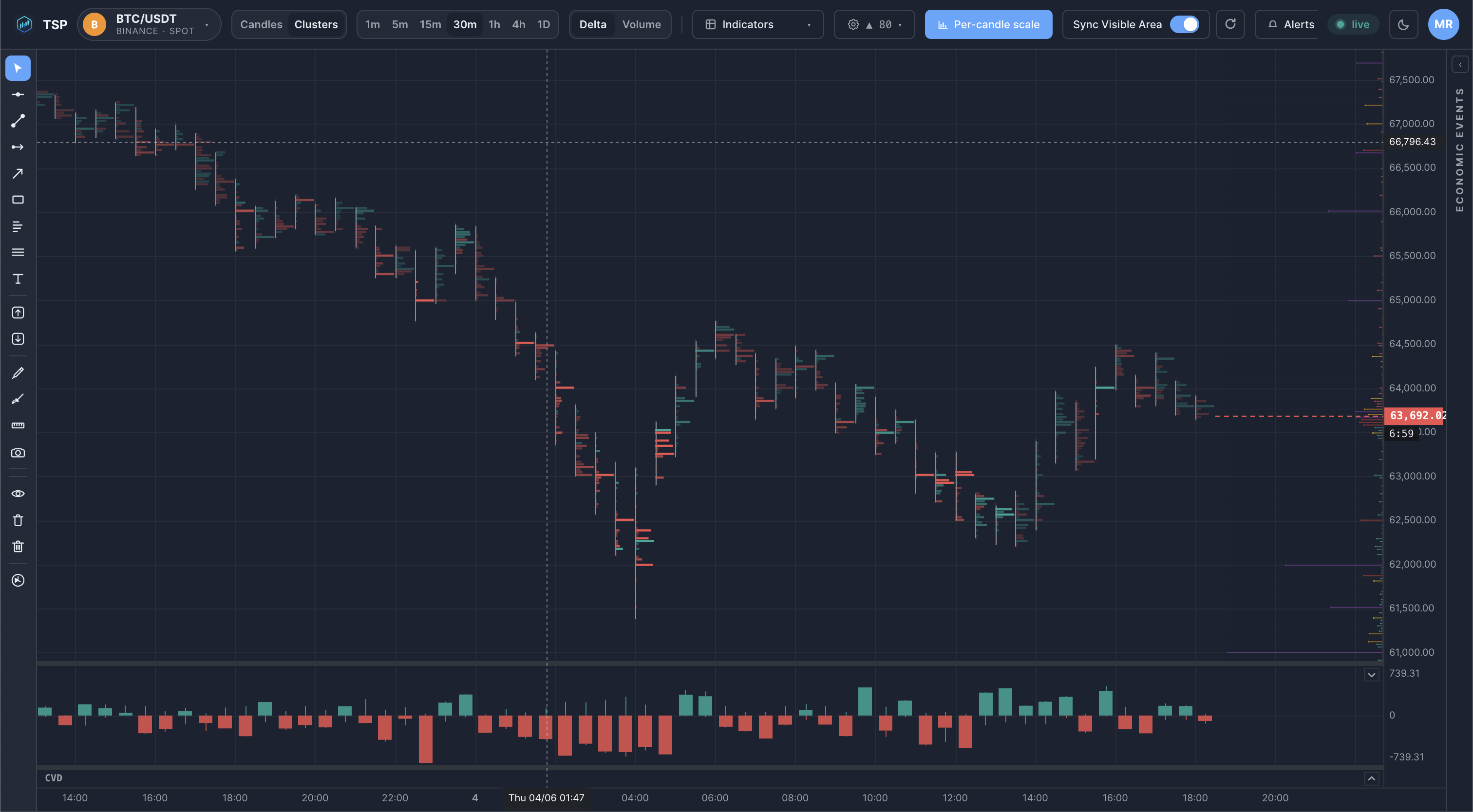
Example on a chart
Common mistakes
- Reading delta as a buy/sell trigger. Delta describes aggression that already happened; it is context, not an instruction.
- Ignoring absorption. Strong delta with little price movement often means the other side is absorbing — the opposite of what the raw sign suggests at a glance.
- Confusing delta with open interest or net positioning. Delta is aggressor-side traded volume, not a measure of who holds what.
How TSP Core visualizes it
TSP Core computes delta live from real-time trades and shows it both as a per-bar value beneath the chart and as per-level figures inside the footprint and cluster columns. The forming bar's delta updates as trades print, and cumulative delta is available alongside it for the over-time view. The live numbers match the values stored in history once the bar closes.
See live delta on crypto markets
Open the TSP Core dashboard and watch per-bar and per-level delta update in real time.