Qu'est-ce que le flux d'ordres ?
Le flux d'ordres est le flot des transactions exécutées et des ordres en attente, lu avec le côté agresseur attaché — quelles transactions étaient des achats agressifs et lesquelles des ventes agressives — décrivant comment l'achat et la vente se sont réellement déroulés, et pas seulement le prix qui en a résulté.
Comment fonctionne le flux d'ordres
Chaque transaction a deux côtés, mais un seul agresseur : le participant qui a franchi le spread pour faire advenir la transaction. Un achat au marché qui prend l'offre en attente est un achat agressif ; une vente au marché qui frappe la demande en attente est une vente agressive. L'analyse du flux d'ordres étiquette chaque transaction exécutée de son côté agresseur et lit l'équilibre courant entre les deux.
Par-dessus se superpose le carnet d'ordres — les ordres à cours limité en attente à chaque prix. Le flux d'ordres est l'interaction entre les deux : des ordres au marché agressifs qui consomment, ou ne parviennent pas à consommer, la liquidité passive du carnet.
Flux d'ordres vs graphique en chandeliers
Un chandelier et le flux d'ordres décrivent le même marché, mais à une profondeur très différente.
| Chandelier | Flux d'ordres | |
|---|---|---|
| Ce qu'il montre | Ouverture, plus haut, plus bas, clôture par barre | Les transactions individuelles avec le côté agresseur, plus la liquidité en attente |
| Répond à | Où le prix est-il allé ? | Qui était agressif, et où le volume s'est-il échangé ? |
| Résolution | Quatre chiffres par barre | Transaction par transaction et niveau par niveau |
| Idéal pour | La tendance et la structure d'un coup d'œil | La lecture de l'absorption, du déséquilibre et de l'épuisement |
Pourquoi le volume d'achat/de vente compte
Raw volume tells you how much traded; the bid/ask split tells you who traded it. That distinction is what makes order flow more than a volume histogram:
Lire le volume du côté agresseur aide à repérer :
- Absorption — heavy aggressive selling that price refuses to follow, implying resting buyers are absorbing it.
- Imbalance — a price where one side's aggression far outweighs the other's.
- Exhaustion — aggression thinning at the extreme of a move.
Ce sont des lectures descriptives d'une activité achevée, non des prédictions sur ce que le prix fera ensuite.
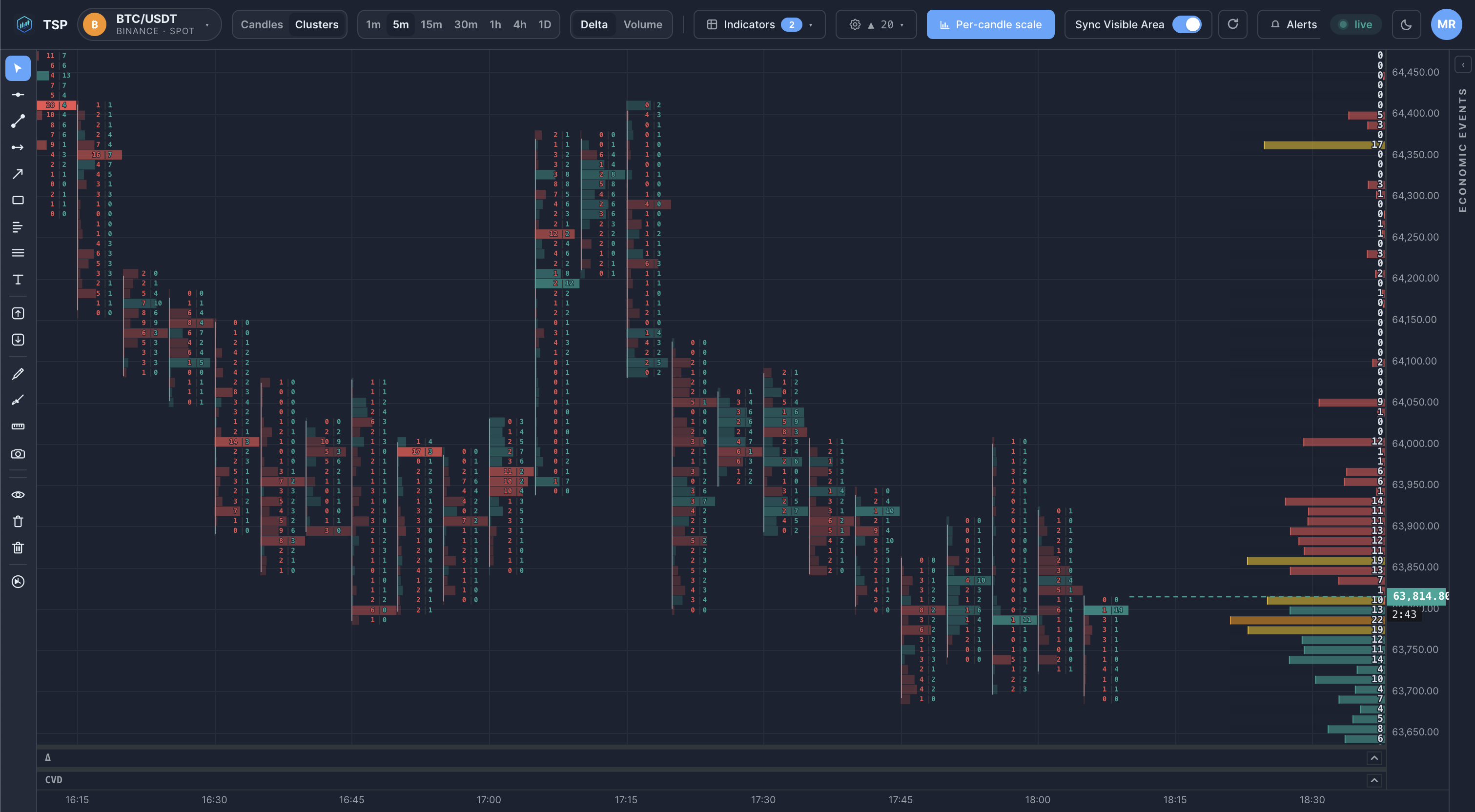
Exemple sur un graphique
FAQ
Qu'est-ce que le flux d'ordres ?
Le flux d'ordres est le flot des transactions exécutées et des ordres en attente, lu avec le côté agresseur attaché : quelles transactions étaient des achats agressifs prenant l'offre et lesquelles des ventes agressives frappant la demande. Il décrit comment l'achat et la vente se sont réellement déroulés, et pas seulement le prix qui en a résulté.
En quoi le flux d'ordres diffère-t-il d'un graphique en chandeliers ?
Un chandelier résume une période en ouverture, plus haut, plus bas et clôture. Le flux d'ordres regarde à l'intérieur de cette période les transactions individuelles et la répartition achat/vente, montrant qui était agressif et où, plutôt que seulement l'amplitude que le prix a couverte.
Quels outils montrent le flux d'ordres ?
Les graphiques footprint et de clusters montrent le flux d'ordres par niveau de prix à l'intérieur de chaque barre ; le delta et le delta cumulé condensent la répartition achat/vente en une valeur signée ; la vue de profondeur de marché montre la liquidité en attente dans laquelle s'échange le flux d'ordres.
Le flux d'ordres prédit-il le prix ?
Non. Le flux d'ordres décrit une agressivité et une liquidité qui se sont déjà déroulées. C'est un contexte analytique pour une analyse autonome, non un signal ni une prévision.
Lire le flux d'ordres sur des données crypto en direct
Ouvrez le tableau de bord TSP Core et observez les achats et ventes agressifs se dérouler en temps réel.