Qu'est-ce qu'un graphique de clusters ?
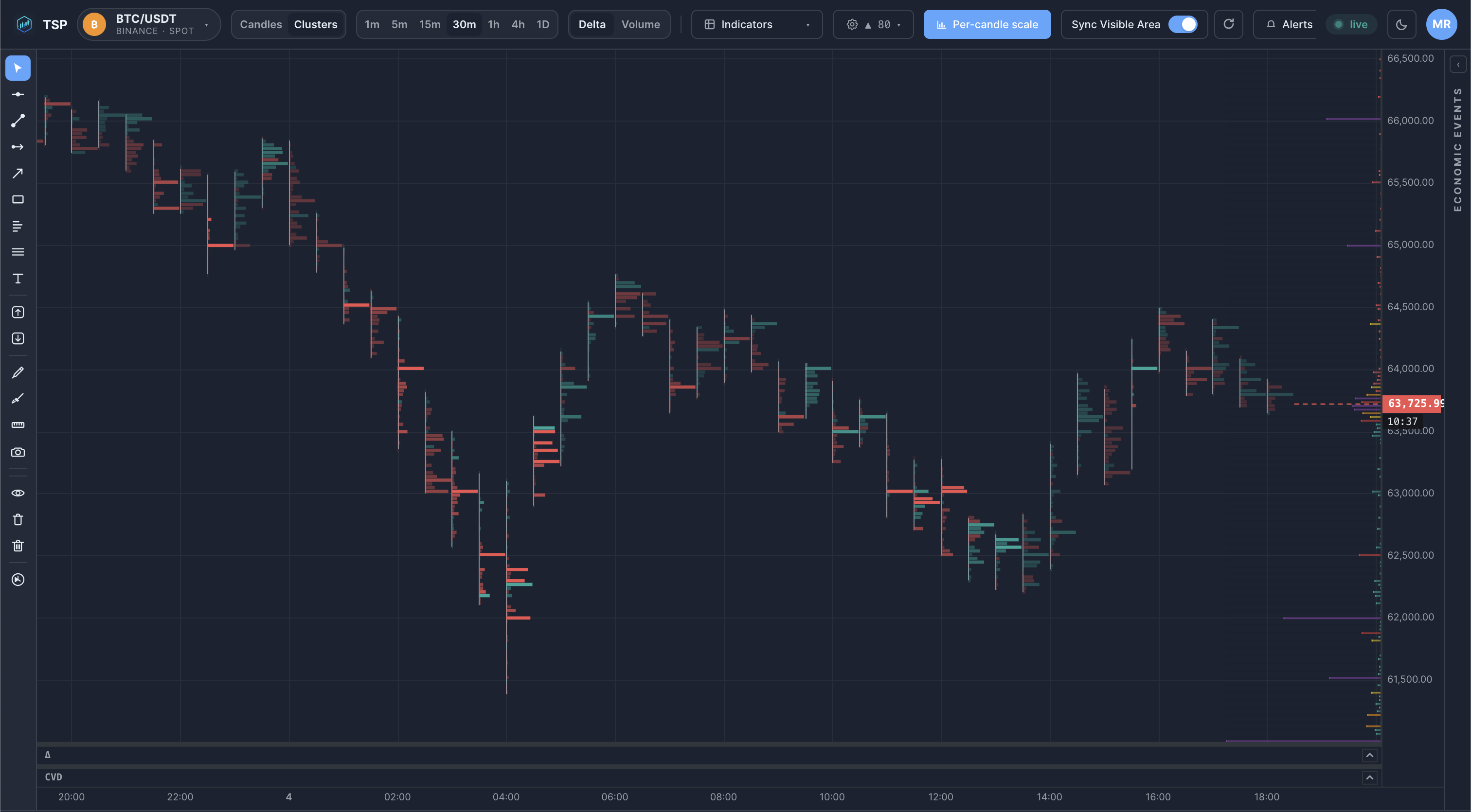
Un graphique de clusters regroupe le volume échangé à l'intérieur de chaque barre en bandes de prix et montre la répartition achat/vente agressive à chaque bande — un graphique footprint dont les niveaux sont agrégés en clusters de prix de taille fixe pour une lecture plus nette.
Comment fonctionnent les graphiques de clusters
Chaque transaction s'exécute à un prix et d'un côté : un acheteur agressif qui prend l'offre ou un vendeur agressif qui frappe la demande. Un graphique de clusters prend ces transactions et les range en bandes de prix d'une taille choisie — disons 50 $ ou 150 $ de large — puis totalise le volume d'achat et de vente dans chaque bande au sein de chaque barre. La barre devient une pile de clusters, chacun annoté du volume qui s'y est échangé et du camp qui était l'agresseur.
Because the band size is configurable, you control the resolution: tighter bands expose fine detail, wider bands smooth a busy bar into a handful of readable clusters. The band size is a price increment, not a timeframe — it does not change how much time the bar covers.
Graphique de clusters vs graphique footprint
Un graphique de clusters et un graphique footprint montrent les mêmes données de flux d'ordres ; ils ne diffèrent que par la finesse du regroupement des prix.
| Footprint | Clusters | |
|---|---|---|
| Regroupement des prix | Peut montrer chaque niveau de prix | Niveaux rangés en bandes de taille fixe |
| Contrôlé par | Le tick de l'instrument | Une taille de bande choisie (incrément de prix) |
| Se lit mieux pour | Le détail fin, niveau par niveau | Les barres chargées, la distribution d'un coup d'œil |
| Mêmes données ? | Oui — le volume d'achat/de vente par prix, simplement à une résolution différente | |
Pourquoi le volume d'achat/de vente compte
Grouping by price is only half the value; the bid/ask split is the other half. Knowing a band traded 1,200 contracts tells you it was busy; knowing 1,000 of them were aggressive buys tells you who was busy. That is the heart of order-flow reading:
La répartition entre clusters aide à repérer :
- Absorption — heavy aggressive selling in a band that fails to push price lower.
- Imbalance — a band where one side's volume dwarfs the other's.
- Where business was done — the cluster that traded the most volume in the bar.
Ce sont des lectures descriptives d'une activité achevée, non des prédictions sur ce que le prix fera ensuite.
Exemple sur un graphique
FAQ
Qu'est-ce qu'un graphique de clusters ?
Un graphique de clusters regroupe le volume échangé en bandes de prix au sein de chaque barre et montre la répartition achat/vente à chaque bande. C'est un graphique footprint dont les niveaux sont agrégés en clusters de prix de taille fixe plutôt que chaque tick individuel.
En quoi un graphique de clusters diffère-t-il d'un graphique footprint ?
Ils montrent les mêmes données de flux d'ordres ; la différence est la granularité. Un graphique footprint peut montrer chaque niveau de prix, tandis qu'un graphique de clusters agrège les niveaux en bandes de prix d'une taille choisie, rendant les barres chargées plus faciles à lire d'un coup d'œil.
La taille de bande des clusters est-elle une unité de temps ?
Non. L'échelle des clusters est un incrément de prix, non un intervalle de temps. Une taille de bande plus grande regroupe davantage de prix dans chaque cluster ; elle ne change pas la période que couvre la barre.
Les graphiques de clusters prédisent-ils le prix ?
Non. Un graphique de clusters décrit comment le volume s'est réparti selon le prix dans des barres déjà échangées. C'est un contexte analytique, non un signal ni une prévision.
Lire les clusters sur des données crypto en direct
Ouvrez le tableau de bord TSP Core et regroupez le flux d'ordres en bandes de prix en temps réel.