Kumulatives Delta (CVD)
Kumulatives Volumen-Delta ist eine laufende Summe des Deltas über die Zeit. Wo das Delta das netto aggressive Volumen eines Balkens misst, addiert das CVD das Delta jedes Balkens zum vorherigen – und zeichnet eine Linie, die zeigt, wie sich die Aggression über eine Session hinweg akkumuliert hat.
Was ist kumulatives Delta?
Beginne bei null und addiere Balken für Balken positives Delta, wenn Käufer aggressiv waren, und ziehe ab, wenn Verkäufer es waren. Das Ergebnis ist eine Kurve. Eine steigende CVD-Linie bedeutet, dass sich aggressives Kaufen akkumuliert hat; eine fallende Linie bedeutet, dass aggressives Verkaufen dominierte. Da es kumulativ ist, glättet das CVD das Balken-für-Balken-Rauschen des rohen Deltas zu einem Trend der Teilnahme.
Das CVD wird üblicherweise an einem aussagekräftigen Start verankert – der Session-Eröffnung, dem Tag oder einem gewählten Punkt –, da der absolute Wert der Linie nur relativ zum Beginn der Zählung Bedeutung hat.
Warum ist das wichtig?
CVD is most useful read against price. The relationship between the two adds context:
- Confirmation — price and CVD rising together describes a move carried by accumulating aggressive buying.
- Divergence — price making a new high while CVD does not may reflect the move running on less aggressive buying than before.
- Absorption — CVD climbing while price stalls is a descriptive sign that resting sellers are absorbing the buying.
Dies sind beschreibende Beobachtungen über akkumulierte Aktivität – Kontext für eigenständige Analyse, keine Prognosen.
Wie Trader es nutzen
- Das CVD am Session-Start verankern und vergleichen, ob es mit dem Preis übereinstimmt oder von ihm divergiert.
- Die Steigung des CVD während eines Schubs nach oben mit dem darauffolgenden Pullback vergleichen.
- Das CVD als zeitlichen Begleiter zum Delta pro Balken und zu Footprint-Lesungen pro Niveau nutzen.
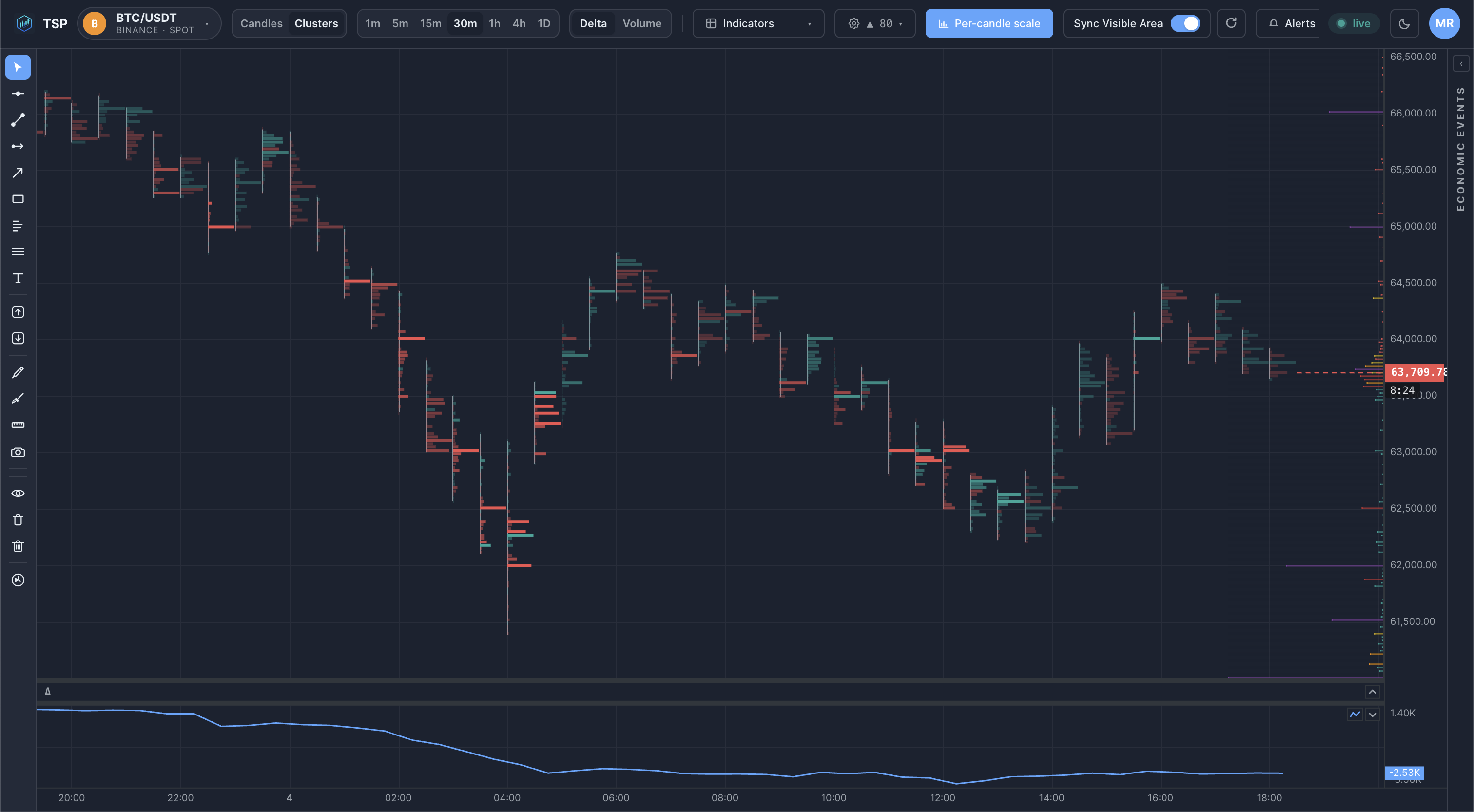
Beispiel im Chart
Häufige Fehler
- Reading the absolute level. CVD's raw value depends entirely on its anchor; what matters is its slope and its relationship to price, not the number itself.
- Treating divergence as a reversal call. Divergence is descriptive context that aggression is changing — not a signal that price must turn.
- Comparing across different anchors. Two CVD lines started at different points are not directly comparable.
So stellt TSP Core es dar
TSP Core plottet das kumulative Delta als Linie unter dem Preischart und baut es live aus dem Echtzeit-Delta auf, während jeder Balken entsteht. Es liegt neben den Ansichten für Delta pro Balken und Footprint, sodass du zwischen dem zeitlichen Bild und dem dahinterliegenden Balken- oder Niveaudetail wechseln kannst. Die Live-CVD-Kurve bleibt konsistent mit den in der Historie gespeicherten Delta-Werten.
Live-CVD auf Krypto-Märkten ansehen
Öffne das TSP-Core-Dashboard und beobachte, wie sich das kumulative Delta gegen den Preis in Echtzeit aufbaut.